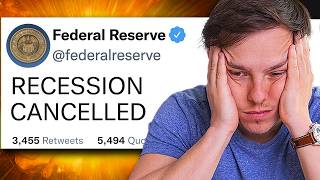
BREAKING: The FED Pauses Rates, Housing Declines, Recession Cancelled

Published: 2023-11-01
Status:
Available
|
Analyzed
Published: 2023-11-01
Status:
Available
|
Analyzed
Predictions from this Video
Incorrect: 0
Prediction
Topic
Status
Zillow forecasts a 2.1% increase in US home prices by September 2024.
"in terms of where this might go over the next year Zillow just released their updated forecast and in it they believe that that home prices will see another 2.1% increase through September of 2024"
Pending
Morgan Stanley predicts a 5% year-over-year rise in US home prices.
"Morgan Stanley revised their forecast and they now believe that home prices could rise another 5% year-over-year"
Pending
Goldman Sachs anticipates a 3.5% increase in US home prices by the end of 2024, assuming no major negative economic shocks.
"a managing director of Goldman Sachs also went on record to say that absent any negative shocks to the broader economy that would either boost excess supply of homes in the market or fuel an uptick and unemployment we continue to expect home prices to rise at a slow pace with his estimate that we'll see a 3 and a half% increase by the end of 2024"
Pending
The current stock market risk premium is abnormally low, suggesting that stocks may need to fall or earnings need to increase significantly to normalize. A fall in treasury yields is considered unlikely by the speaker based on Jerome Powell's comments.
"the risk premium like this generally hovered around 3.1% which basically means if treasuries are paying 5% you should expect to make 8.1% in the stock market for taking on extra risk but to today that risk premium is the lowest it's been since 2009 at just 1% and as Josh pek would say the math just ain't math in this case it's suggested that in order for the risk premium to return to its normal level stocks either need to fall or earnings need to go up by a lot alternatively the 10-year treasury yield could also fall but given some of the recent comments by Jerome Powell this is unlikely to happen anytime soon"
Pending
Historically, there have been instances in developed countries, such as Japan starting in 1986, where a 20-year stock market holding period resulted in losses.
"throughout most of the world there are a variety of instances where a 20-year holding period has actually lost money with the most notable being Japan their economic downfall began in 1986"
Pending
There is a 9% chance of a 'Japan-like' economic event (prolonged stock market stagnation or decline) occurring in the United States, considering global historical data and potential survivorship bias in US data.
"when you take a look throughout the world there are plenty of developed countries that have lost money over a long period of time and that of course leads us to wonder what are the chances of that happening here well according to the market sentiment blog since 1890 once you add inflation into the mix there's only a 1.2% chance of losing buying power over a 30-year Horizon although this doesn't really take into consideration that we only have 130 years worth of data to pick from and the United States could be suffering from survivorship bias where we only look at it because so far it's worked that's why when we zoom out to a global market according to this research there is a 9% chance that a Japan likee event could happen here in the United States at some point in the future"
Pending
Jerome Powell indicated that significant tightening in financial conditions could influence the future path of monetary policy.
"Jerome Powell stated that Financial conditions have tightened significantly in recent months We remain attentive to these developments because persistent changes in financial conditions could have implications for the path of monetary policy"
Pending
The Federal Reserve is adopting a 'wait and see' approach to future rate hikes and is prepared to adjust policy as necessary.
"Jerome pal once again reiterated that they're taking a wait and see approach to Future rate hikes and they're willing to adjust as needed"
Pending
Analysts are observing trends that suggest a potential 'rolling recession' where only specific industries contract, or a 'richcession' where job and pay cuts are concentrated among high-earning tech and finance workers.
"today analysts are pointed the trends that might call for a rolling recession in which only some Industries shrink while the broader economy remains above water others are even calling it a rich session"
Pending
US GDP grew at a 4.9% annual pace, indicating strong consumer spending despite economic challenges and higher interest rates. This is the largest increase since Q4 2021.
"the US GDP recently grew to 4.9% annual Pace signaling that despite what's happening with the economy and higher interest rates people are still spending a lot of money in fact this is the largest GDP increase since the fourth quarter of 201 21"
Pending
Seven major tech stocks (Apple, Google, Amazon, Microsoft, Meta, Nvidia, and Tesla) are disproportionately driving the S&P 500, making up 30% of its market cap, a concentration last seen at the 2021 market peak.
"as of right now only seven stocks are holding up the index and that would be apple Google Amazon Microsoft meta Nvidia and Tesla in fact an equity strategist Bank of America calculated these seven companies as currently making up 30% to the S&P 500's total market cap the last time this happened was at the 2021 peak of the market before everything started falling"
Pending